CasteStudy
"Nobody to join the Untouchable": a philosopher takes Ambedkar's graded inequality beyond caste
Yarran Hominh argues that oppression is not usually a matter of two groups, one on top and one below, but of many groups ranked one above another, the structure B. R. Ambedkar called graded inequality. He uses caste as the model, applies it to capitalism and to race in the United States, and names two ways the ranking keeps itself going.
Key findings
- Hominh argues that "a better model for the structure of systems of group-based oppression and domination is one of graded inequality", a term he takes from Ambedkar, in place of the common model of one oppressor group and one oppressed group (p. 1).
- He uses caste as the clearest case of that structure, not as a label for other systems: "I use the abstract structure of caste as a model to understand better systems of oppression and domination" (p. 2).
- The first way the ranking holds itself up is group interest. Groups above the bottom gain from being above someone, so they defend the order. He draws on Ambedkar's account of the Shudras, who act as "police force of the Brahmins" and are "not prepared to see the Untouchable raised to his level" (p. 10).
- The second he calls affective misdirection: hope and anger that could be turned against the whole system are turned instead towards rising within it or against the groups nearest in rank. "One can only rise within a system if that system continues to exist" (p. 12).
- He says this is not a ranking of whose suffering is worst. Graded inequality is about "identifying structural dynamics that shape (but do not determine) those experiences", not about "ranking the severity of groups' experience of oppression" (p. 15).
This brief explains: Yarran Hominh, "Oppression, Domination, and the Structure of Graded Inequality", Philosophers' Imprint 24, no. 15 (November 2024). doi:10.3998/phimp.3192. CC BY-NC-ND 4.0 Read the original
If the Hindu social order was based on inequality, it would have been over-thrown long ago. But it is based on graded inequality … [and so] there is nobody to join the Untouchable in his struggle.
i
Source: Philosophers' Imprint 24(15), 2024, p. 11Many theories of oppression picture two groups: the oppressor and the oppressed, men and women, capitalists and workers, white and Black. In this paper the philosopher Yarran Hominh argues that the picture is too simple. Most systems of oppression, he writes, have many groups ranked one above another, and the ranking itself does work that a two-group picture cannot see.
He takes the name for that structure from B. R. Ambedkar: graded inequality. “I take this notion of graded inequality from B. R. Ambedkar, who uses it to describe the Indian caste system” (p. 1).
What the study argued
The two-group model. Hominh grants that the binary model “contains some truth” (p. 5). Groups often form because one dominates another, and singling out one target can have political force. But “the paradigm cases of systematic oppression and domination are not binary” (p. 4). Racism in the United States involves more than white and Black; capitalism involves more than owners and workers.
Caste as the model. He defines graded inequality as “a structure that comprises groups in multiple strata arranged in a hierarchical order” (p. 6), each with different rights, privileges and duties, and each closer to or further from the norm set by the top group. Caste is his clearest case. He quotes Ambedkar that the varnas “are not on a horizontal plane, different but equal. They are on vertical plane…unequal in status, one standing above the other” (pp. 6–7). He is careful about what this claim does and does not mean: “I do not imply that is all those systems are, nor that they are forms of caste. Rather, I use the abstract structure of caste as a model” (p. 2).
The model applied. He then reads two other systems this way. Under capitalism, between the owners at the top and the unemployed at the bottom, there are professionals, small owners, skilled and unskilled workers. Drawing on Marx, he argues that the skilled “work to maintain their position ahead of the unskilled” (p. 8), and that a simple owner-and-worker picture “occludes our vision of how solidarity between workers is structurally discouraged” (p. 8). For race in the United States he uses Eduardo Bonilla-Silva’s idea of a three-tier order, in which some groups are treated as “honorary whites”, while saying he does not endorse it as the most accurate account (p. 9).
Group interest. The first mechanism that keeps a graded order stable is that groups above the bottom gain from being above someone. “Since protection of this interest involves maintaining the structure of graded inequality, this moral psychology of group interest serves to stabilize the system as a whole” (p. 10). His example is Ambedkar’s account of the Shudras, who are oppressed themselves but act as “police force of the Brahmins” and are “not prepared to see the Untouchable raised to his level” (p. 10). Hominh says the Shudras’ real interest lies elsewhere: “Shudras would be far better off if caste were abolished” (p. 11). Their interest in their rank is real all the same, and it can show up as pride or as “consolation in the fact they are not at the bottom” (p. 11). This, he argues, is what Ambedkar meant when he said graded inequality is more stable than simple inequality, because “there is nobody to join the Untouchable in his struggle” (p. 11).
Affective misdirection. The second mechanism concerns feeling. Hope and anger could fuel action against the whole system. In a graded order, hope becomes hope for “upward mobility” (p. 12), for oneself or one’s group, and “One can only rise within a system if that system continues to exist” (p. 12). Anger is turned against the groups just below (“punching down”) or nearby, rather than at the order itself. Here he quotes Ambedkar’s description of caste as “an ascending scale of hatred and a descending scale of contempt” (p. 12).
Three objections. Hominh closes by answering three worries. Real systems are messier than caste: he replies that he is abstracting a structure from caste, and that “it is precisely because caste is so unique that it is useful” (p. 13). Graded inequality might be the same as intersectionality: he argues the two are related but distinct, and that they complement each other (pp. 14–15). And it might rank oppressions: he says the ranking is of positions in a structure, not of how much people suffer (p. 15).
Why it matters
Ambedkar is often cited as a thinker about caste alone. This paper treats one of his ideas as a general account of how oppression works, published in a philosophy journal and set beside Marx, Frye and theorists of race. It also gives a careful reading of a point Ambedkar returned to again and again: graded inequality keeps the oppressed from uniting, because almost every group has someone below it to lose to.
The argument speaks to questions that come up in Dalit politics now: why caste groups that are themselves held down can enforce caste on Dalits, why solidarity across caste lines is so hard to build, and why hope for one group’s rise can leave the whole order standing. The paper does not study any of these on the ground, but it offers a way to ask them.
What the study does not show
- Evidence. It is a philosophical argument. It does not measure how often groups in the middle enforce the order, or test the model against data.
- Caste today. Its picture of caste comes mainly from Ambedkar and the varna order. It does not trace how ranking works among jatis in one region now.
- Dalit scholarship. Dalit scholars besides Ambedkar are cited in the notes but their arguments are not taken up in the text.
- Resistance. The paper explains why graded orders are stable. It says understanding that is “a step toward destabilizing them” (p. 10), but it does not study how Dalit movements have built alliances across castes.
Talking points
- Ambedkar said there is “nobody to join the Untouchable in his struggle”. Where has that been true, and where have groups above Dalits joined anyway?
- Hominh argues that hope for one’s own group to rise can keep the whole order in place. How does that sit with reservation, which helps some groups rise?
- He uses caste to explain racism and capitalism, without saying they are caste. Is that a fair use of Ambedkar’s idea, or does it pull it away from the people it was written about?
The work
Yarran Hominh, “Oppression, Domination, and the Structure of Graded Inequality”, Philosophers’ Imprint 24, no. 15 (November 2024), 18 pages. doi:10.3998/phimp.3192. Published under a Creative Commons Attribution-NonCommercial-NoDerivatives 4.0 licence.
About this study
- Who made it
- Yarran Hominh, a philosopher at Bard College. The paper appeared in Philosophers' Imprint, an open-access philosophy journal, after peer review. In his acknowledgements he thanks a social philosophy workshop and two anonymous reviewers.
- How it was done
- A work of social and political philosophy. It builds an argument from texts rather than collecting new data: Ambedkar's writings (Annihilation of Caste, Castes in India, The Hindu Social Order and Untouchables or the Children of India's Ghetto, from the Writings and Speeches volumes), Marx's Capital, and theorists of oppression and race such as Marilyn Frye, Ann Cudd, Charles Mills and Eduardo Bonilla-Silva. This brief is based on the full text of the paper. Page numbers are the article's own.
- What it does not show
- The paper tests its model against examples, not evidence: caste, capitalism and race in the United States are used to illustrate the structure, and the author says these are "intended solely as illustrations" (p. 7). Its account of caste rests mainly on Ambedkar and leans on the varna order, which he says is what Ambedkar "primarily has in mind" (p. 6); it does not look at how the ranking works among jatis in a given place today. Dalit scholars other than Ambedkar appear in the footnotes but are not discussed. The crime figures in its footnote 31 are quoted from NCRB and Equality Now and were not checked for this brief.
- Corrections
- Corrections policy
More on Caste
Study
“Land to the tiller, but what about landless labour?”: Ambedkar on caste and land, read by Awanish Kumar
In a 2020 article, Awanish Kumar argues that B. R. Ambedkar saw the land monopoly of caste Hindus as the material basis of caste, distrusted land reform built on peasant owners, and backed Dalit struggles to take over waste and common land.
Book
“Caste is a notion”: Ambedkar's Annihilation of Caste, the speech Lahore would not hear
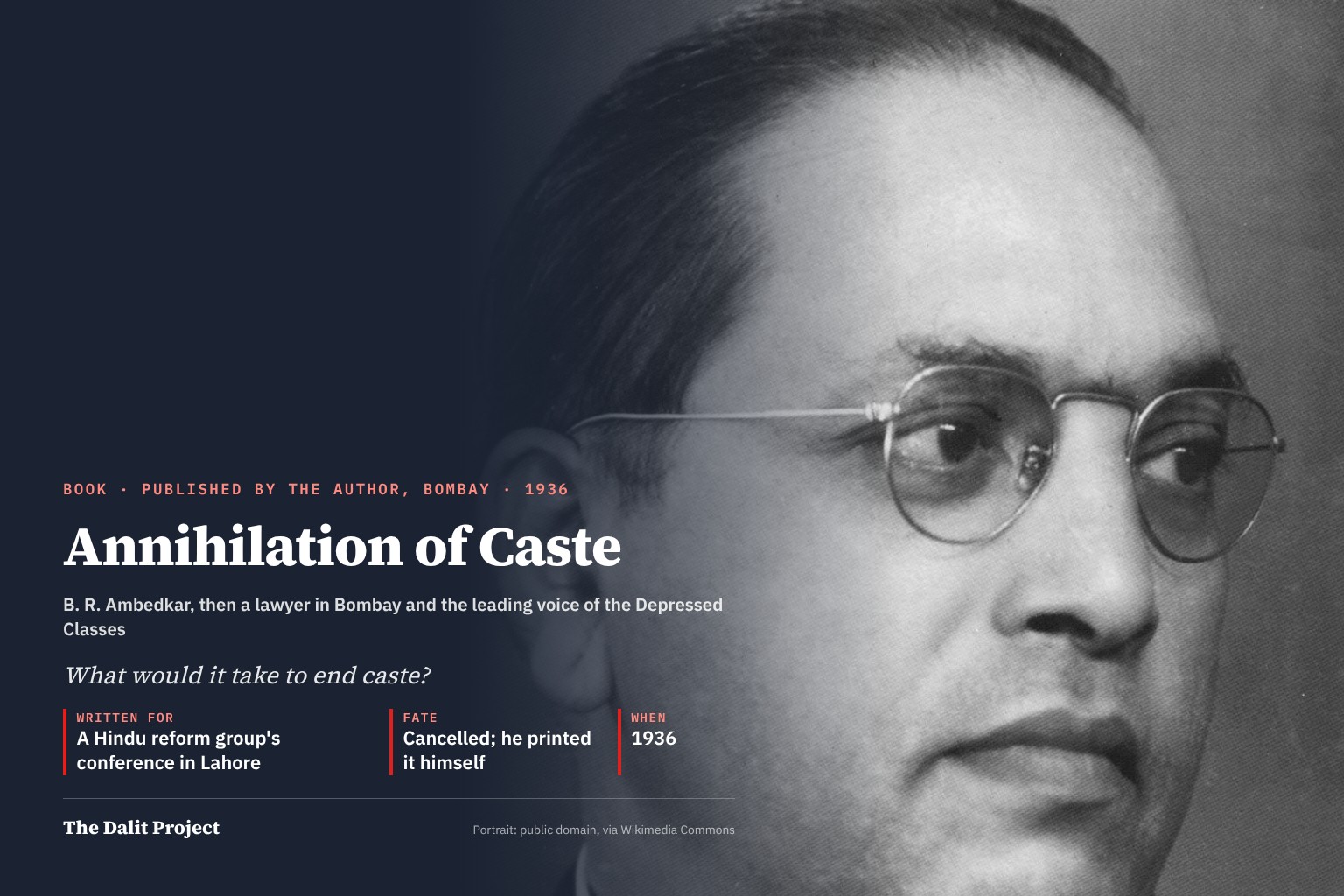
In 1936 B. R. Ambedkar wrote a speech for a Hindu reform group in Lahore. When he would not cut his attack on the scriptures, the group cancelled its conference, so he printed the speech himself. It argues that caste can end only when people stop believing the scriptures that make it sacred.
Study
“A Caste is an Enclosed Class”: Ambedkar's 1916 theory of how caste began
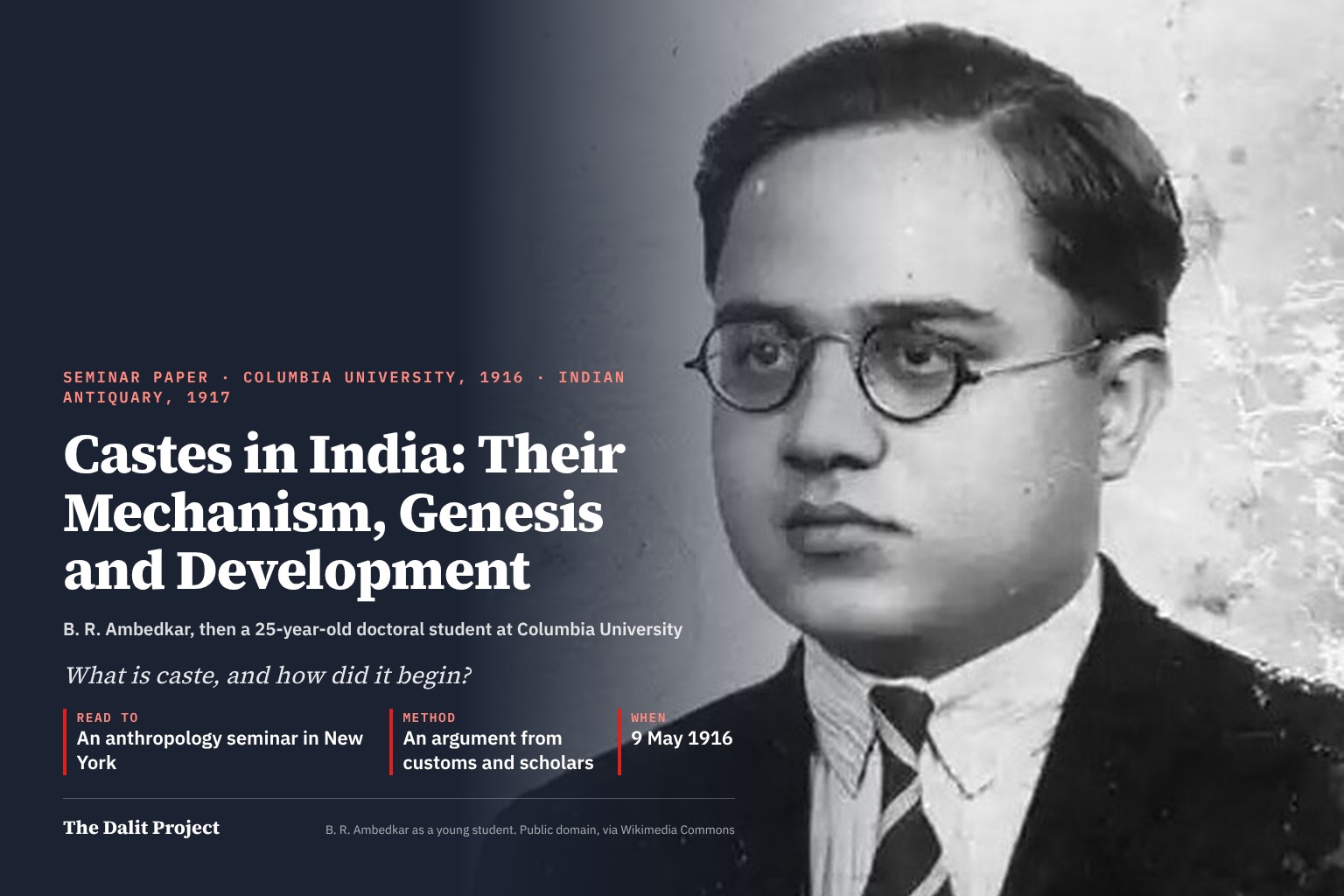
In a seminar paper at Columbia University in 1916, a 25-year-old B. R. Ambedkar argued that caste is marriage closed within the group, held in place by controlling women, and that it spread by imitation and by exclusion.
Book
“Humiliation is a struggle concept”: Gopal Guru's Humiliation: Claims and Context
This 2009 book, edited by Gopal Guru, brings together twelve essays by eleven scholars that treat humiliation as a subject of political theory in its own right. Its central argument is that humiliation is a claim made by people who have come to expect respect, and that untouchability is its Indian form.
“Caste is a notion”: Ambedkar's Annihilation of Caste, the speech Lahore would not hear
“A Caste is an Enclosed Class”: Ambedkar's 1916 theory of how caste began
"Not merely a division of labour": Ambedkar on caste and work, and what racial capitalism adds
“A Dalit still remains a Dalit”: a study of the communist movement and the caste question, 1926–2016